
Wireless chargers
The Qi1001 induction charger, a universal Qi standard, integrates invisibly into your furniture and reliably charges iPhone, Samsung, LG, Google Nexus, and many others at the same speed as a standard cable. For older, incompatible smartphones (iPhone 5-6-7, older Android), the Qi2001 receiver makes them compatible, available with a Lightning or micro-USB output.
3 products
Sort by:
3 products


Bring wireless charging to your Lightning iPhone
Does your iPhone lack native induction charging? The Qi2001 receiver is the simple and elegant solution: plug it into the Lightning port, place your smartphone on any Qi charger, and charging begins instantly. 20g, 5.5mm thick — you'll almost forget it's there.
What is the Qi2001 receiver?
The Qi2001 receiver is a wireless charging adapter specifically designed for iPhones equipped with a Lightning connector (iPhone 5, 5S, 5C, SE 1st gen, 6, 6 Plus, 6S, 6S Plus, 7, and 7 Plus). It plugs discreetly into your device's Lightning port and provides compatibility with any standard Qi induction charger.
Designed by the Qinside brand, this ultra-slim receiver slips easily behind your phone, even with certain cases. A blue LED light indicates the connection status. Simple, reliable, efficient.
Why switch to wireless charging?
Simply place your iPhone on the pad and enjoy clean, frictionless daily charging.
Only 5.5 mm thick and 20 g — you'll almost forget it's there, even when tucked under a slim case.
Compatible with all Qi-certified wireless charging stations, regardless of the brand.
No apps, no setup. The receiver works as soon as it is connected to the Lightning port.
Avoid Lightning port wear by reducing repetitive plugging and unplugging thanks to induction charging.
A blue LED indicator confirms instantly that charging is underway. No doubt, no surprises.
Technical Specifications
Compatibility: which iPhones?
This receiver is designed for all iPhones with a Lightning port that do not have native Qi wireless charging:
How to use the Qi2001 receiver?
Frequently Asked Questions
Product Information
Your iPhone 5, 6, or 7 also deserves to enjoy wireless charging.
The Qi2001 receiver offers this freedom in seconds:
Plug · Place · Recharge
Compact, universal, and so practical for daily use — it's the little accessory that truly changes the way you charge.


Bring wireless charging to your Android smartphone
Does your Android smartphone not have native wireless charging? It’s not the end of the world. The Qi2001 receiver with micro USB connector is an ultra-flat adapter that plugs discreetly into your phone's port and instantly adds compatibility with standard Qi wireless chargers. No need to change phones: just place it down, and you're good to go.
Why choose an induction adapter instead of changing your phone?
A fraction of the price of a new smartphone, for identical functionality.
Works with all Qi-certified wireless charging stations available on the market.
Fits naturally under your phone case without making it bulky.
No setup, no pairing: plug it in and set it on the pad—that's it.
How to use the Qi2001 receiver?
Insert the micro USB connector of the Qi2001 receiver into the charging port of your Android smartphone.
Slide the flat module between your phone and its protective case for a clean, discreet finish.
Simply place your smartphone on any Qi-compatible wireless charging pad or station. Charging starts automatically.
Compatible Android smartphones
This micro USB induction charging adapter is designed for all Android devices with a micro USB port—the vast majority of smartphones released before 2018. Here are some examples of compatible models:
⚠️ This receiver is exclusively compatible with devices equipped with a micro USB port. For recent smartphones equipped with a USB-C port, a dedicated version is available.
Technical specifications
| Specification | Detail |
|---|---|
| Connector type | Micro USB (Android) |
| Charging standard | Qi (compatible with all Qi stations) |
| Length | 55.6 mm |
| Width | 54.4 mm |
| Height (thickness) | 5.5 mm |
| Weight | 20 g |
| Brand | Qinside |
| Charging mode | Wireless induction |
Ultra-compact format
What you really gain every day
Imagine: you get home, place your phone on the pad on your nightstand or desk, and that's it. No cable to look for in the dark, no fumbling for a connector, no port damaged from daily plugging in.
The Qi2001 receiver turns a daily chore into a natural, fluid motion—without touching your current phone and without unnecessary expense.
It is also an excellent way to extend the life of your device's micro USB port, which is often weakened by years of repeated connections.
Frequently Asked Questions
Slight heating is perfectly normal and expected during induction charging—it's the very principle of the technology. It poses no danger to your device under normal conditions of use.
Yes. The Qi2001 receiver is designed to work under a thin case (up to about 3mm thick). Plastic, TPU, or silicone cases are generally compatible. Cases with integrated wallets or metal plates, however, may interfere with charging.
Yes, as long as your induction charger is Qi standard certified. It is therefore compatible with the vast majority of wireless charging pads and stations available on the market, regardless of the brand.
No. Once the receiver is plugged into the micro USB port, it is occupied. To charge by cable, you will need to remove the receiver. This is why it is recommended to use it permanently in combination with a Qi station at home or at the office.
The Qi2001 micro USB receiver is wireless freedom at your fingertips—without changing phones, without compromise.
Place it, charge it, live it. It's that simple.
Discover the Eubiq range


Add wireless charging to your desk, table or bedside table. A discreet way to charge a Qi-compatible smartphone without having to plug a cable into the phone.
Why choose this charger
Place your Qi-compatible smartphone over the charging area to charge it.
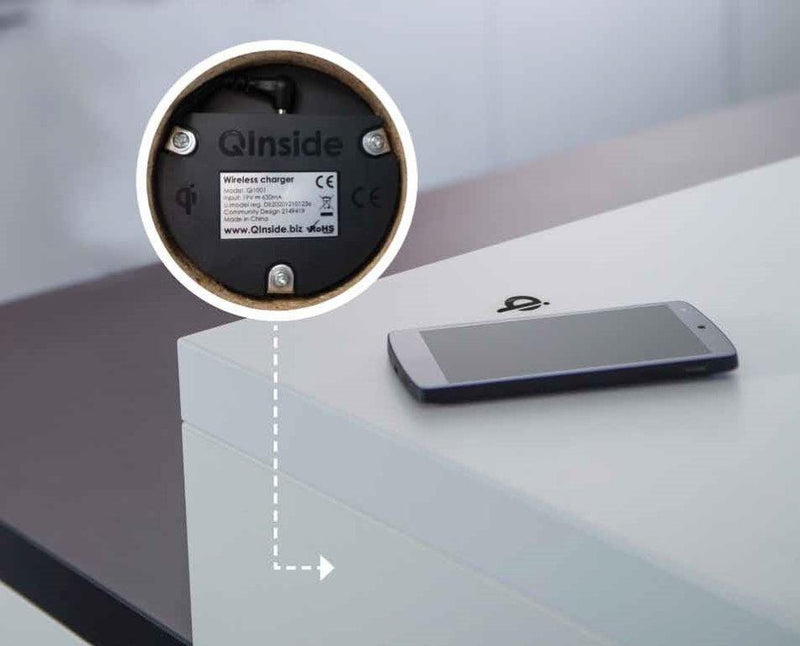
Under the surface of the furniture for an invisible installation, or in a drilled hole with the cover provided.
The charger comes with its power adapter, a 1 m cable and a cover.
Charging built into your furniture
The Qi1001-V4 can be fitted into new or existing furniture: desks, tables, bar counters or bedside tables. It is suitable for non-metallic, non-conductive materials.
This Qinside charger is a stand-alone product: it is built into furniture and does not fit onto an Eubiq power track.
Technical specifications
| Brand | Qinside |
| Reference | QI1001-V4 |
| Installation | Built into furniture |
| Technology | Wireless charging, Qi standard |
| Power | 15 W |
| Supply voltage | 5 V / 9 V, power adapter included |
| Charger dimensions | Ø 8 cm × height 1.55 cm |
| Cable length | 100 cm |
| Weight | 223 g |
| In the box | Charger, power adapter, 1 m cable and cover |
| Certifications | EN55022:2010+AC:2011, EN61000-3-2, EN61000-3-3, EN55024, EN61000-4-2, EN61000-4-3, EN61000-4-4, EN61000-4-5, EN61000-4-6, EN61000-4-8, EN61000-4-11, EMC 2014/30/EU |
Installation and use
For an invisible installation, rout a recess leaving 3 mm of material between the charger and the surface. For an installation with the cover, drill a hole 8 cm in diameter.
Install the module according to its documentation, then connect the power adapter supplied.
Place a Qi-compatible device over the charging area. The charger charges one device at a time.
Installation video
Frequently asked questions
Which phones can be charged?
The charger is designed for smartphones that support Qi wireless charging. Please check that your device is compatible before use.
Can it be installed under a metal surface?
No. Metal or electrically conductive surfaces are not suitable for this installation.
Can the charger be invisible?
Yes. It can be fitted under the surface of the furniture by routing a recess that leaves 3 mm of material between the charger and the surface. Follow the installation instructions.
Can several phones be charged at once?
No, the Qi1001 is designed for one device at a time.
What if my phone doesn’t support Qi charging?
A suitable receiver may be needed. See the Qi2001 receiver pages for micro-USB or iPhone and check their compatibility with your model.
Does this charger fit onto an Eubiq power track?
No. This Qinside product is independent of the Eubiq power track system and is built directly into furniture.
Before drilling, check the material and thickness of the furniture, your phone’s Qi compatibility and the instructions in the documentation supplied.
Which induction charger is right for you?
Answer 3 simple questions to identify the wireless charging solution best suited to your smartphone and your usage. In less than a minute, you will know exactly what you need.
Question 1 of 3
Which smartphone do you want to charge wirelessly?
Native Qi compatibility depends on the model. This question is essential to determine if an additional accessory is required.
Question 2 of 3
Do you already have a Qi induction charger?
This allows us to know if you need the charger alone, a receiver alone, or a complete kit.
Question 3 of 3
What is your main priority?
This helps us narrow down the recommendation between a practical all-in-one kit or separate items.
Your personalized recommendation
Why switch to a built-in wireless charger?
If you work from home or share an office, you know the scene: three charging cables competing for the same power strip, a pad sliding off the edge of the desk, and that wire that always ends up getting caught in the drawer. Let's be honest, it's annoying.
A built-in induction charger solves the problem at the root. Integrated directly into the furniture, it disappears completely. Only a discreet marking on the surface indicates where to place the phone. No visible cables, no clutter, no pad to reposition twenty times a day.
This format appeals to quite a variety of users:
- The remote worker who wants a clean and functional desk
- The kitchen designer who integrates charging into a countertop
- Hospitality professionals—hotels, coworking spaces, meeting rooms—who offer a discreet service to their clients
A common mistake? Buying a classic charging pad to put on the desk when a built-in model would be much better suited for sedentary use. A pad gets moved, knocked over, and takes up space. A built-in charger is part of the furniture. It is a durable installation, designed to stay in place for years.
How does induction charging work through furniture?
The principle is simpler than one might imagine. Wireless charging relies on the Qi (pronounced "chee") standard, adopted by Apple, Samsung, Google, and almost all smartphone manufacturers. It is the universal standard, and that is reassuring.
In concrete terms, two coils come into play: one in the charger (the transmitter), the other in your phone (the receiver). When they are close enough, a magnetic field is created between the two and transfers energy. No direct contact is required—and that is precisely what makes integration possible.
The charging module is fixed under the surface of the furniture. The energy passes through the material—wood, laminate, fine stone—provided the thickness remains reasonable. The Qi1001-V4 induction charger, for example, works through surfaces up to 20-25 mm depending on the material. Beyond that, the signal weakens and charging becomes unstable.
Regarding power, there are three levels on the market:
- 5W: slow charging, enough to maintain the battery level during the day
- 10W: medium charging, a good compromise for most uses
- 15W: fast charging, the one for the Qi1001-V4. Expect about 2.5 to 3 hours for a full charge depending on the phone model
And what about smartphones that don't have Qi natively? That’s where the external receiver comes in. A small, thin accessory—in micro USB or Lightning—that plugs into the phone and adds wireless charging compatibility. We'll talk more about that right after.
Criteria for choosing the right built-in induction charger
This is the section that will really help you decide. Because between power, compatibility, the furniture material, and the module dimensions, there are quite a few parameters to check before picking up the drill.
Output power: 5W, 10W, or 15W?
The higher the power, the faster the charge—it's logical. But be careful: your phone must also support this power. An iPhone 14, for example, caps out at 7.5W in Qi. A Samsung Galaxy S24 accepts up to 15W. In both cases, the charger adjusts automatically, so there is no risk of overloading. But if you are investing in a 15W model like the Qi1001-V4, you might as well have your smartphone benefit from it.
Native compatibility or external receiver?
This is THE first thing to check. Qi charging is integrated natively in:
- iPhones from model 8 onwards (2017)
- Samsung Galaxy from the S6 onwards (2015)
- Google Pixel from Pixel 3 onwards
- Most recent high-end smartphones (Xiaomi, OnePlus, Huawei...)
If your phone is older—an iPhone 5, 6, or 7, or an Android with a micro USB port—you need an external Qi receiver. The Qi2001 receiver for iPhone 5/6/7 or the Qi2001 micro USB receiver for Android do exactly that job. These are thin patches that plug into the phone port and add the wireless function. It's not ideal long-term, but it works very well in a pinch.
Surface material and thickness
This is a criterion that generalist sites often forget. And yet, it is crucial. Induction charging goes through the following without any problems:
- Solid wood (up to 20-25 mm depending on density)
- Laminate and melamine
- Bamboo, MDF
On the other hand, metal completely blocks transmission. Very thick glass and dense stone can also cause problems. Before buying, measure the thickness of your tabletop and check the charger specs. It sounds silly, but it's the number one mistake.
Dimensions and installation depth
The module must fit under the tabletop without weakening the furniture structure. Check the necessary drill diameter and the casing depth. On a standard 25 mm thick desk, the Qi1001-V4 installs comfortably. On a thicker kitchen countertop, you may need to mill it to reduce the thickness locally.
Reliability and brand
Qinside is a specialist in induction charging for furniture, with a range designed for interior design professionals. It is a niche player, but that is precisely what makes their products high-quality: they only do this, and they do it well. Honestly, for this type of product, it is better to go with a specialist than a generalist that offers fifty different categories.
Traps to avoid
- Buying a charger without checking the tabletop thickness—we said it, but it bears repeating
- Confusing Qi and Qi2: Qi2 is the new magnetic standard (inspired by Apple's MagSafe), but current built-in chargers use classic Qi, which is perfectly functional and universal
- Forgetting the receiver for an older phone model and ending up with an unusable charger
Comparison table: which induction charger for which use?
To get a clear picture at a glance, here is a summary of the available solutions:
| Product | Power | Recent iPhone (8+) | Recent Android | Receiver included | Main use |
|---|---|---|---|---|---|
| Qi1001-V4 only | 15W | ✅ Native | ✅ Native | No | Recent smartphone, universal use |
| Pack Qi1001-V4 + micro USB receiver | 15W | ❌ | ✅ Via receiver | Yes (micro USB) | Older Android without native Qi |
| Pack Qi1001-V4 + iPhone receiver | 15W | ✅ Via receiver | ❌ | Yes (Lightning) | iPhone 5, 6, or 7 |
| Qi2001 micro USB receiver | - | ❌ | ✅ | Accessory only | Adding Qi to older Android |
| Qi2001 iPhone receiver | - | ✅ | ❌ | Accessory only | Adding Qi to iPhone 5/6/7 |
Good to know: if your smartphone is recent (2018 or newer), the Qi1001-V4 charger alone is sufficient in the vast majority of cases. For an older model, opt for a pack with a receiver—it’s simpler and often more cost-effective.
What you need to know before installing a built-in charger
Before taking out the drill, a few points deserve your attention. Nothing to be alarmed about, but it’s best to be prepared.
Impact on the battery
This is the question that always comes up. Induction charging does indeed generate slightly more heat than a classic cable. But certified Qi chargers include protections: automatic shut-off at 100%, thermal regulation, foreign object detection. On modern lithium-ion batteries, the long-term impact is marginal. You won't ruin your battery by using a wireless charger daily—studies confirm this.
Compatibility with cases
Most thin cases (less than 3 mm) are no problem: silicone, soft plastic, thin leather, everything works. On the other hand, cases with an integrated metal plate (those for magnetic car mounts) block charging. Very thick reinforced cases can also interfere. When in doubt, remove the case and test it.
Practical installation
You have to drill or mill the furniture to house the module. Nothing very complicated if you have a drill and a suitable drill bit. Also, plan for a passage for the USB power cable under the tabletop. No need for electrical skills—it is very low voltage. A skilled DIYer can install this in 20 minutes.
Incompatible materials
We repeat it because it is important: metal surfaces are totally incompatible. Glass over 8-10 mm thick and dense stone (thick granite, for example) can also block transmission. Always check the specifications of the chosen model before you start.
In summary: how to choose your built-in induction charger
In the end, three questions are enough to make the right choice:
- What power? 15W if you want fast charging and your phone supports it
- Which smartphone? Recent with native Qi, or older requiring a Qi2001 receiver
- Which piece of furniture? Check the material and thickness of the tabletop before any purchase
The Qinside range covers the most common cases, from individual desks to professional reception counters. Feel free to consult the product sheets to verify compatibility with your exact configuration—tabletop thickness, smartphone model, connector type. It’s better to spend two minutes checking than to receive an unsuitable product.
Frequently asked questions about built-in wireless charging
How do I know if my phone is compatible with a wireless charger?
First, check if your smartphone integrates Qi natively. This is the case for all iPhones from model 8 onwards, Samsung Galaxy phones since the S6, and Google Pixel phones since the Pixel 3. You can also search for "wireless charging" in your phone's settings. If the option doesn't appear, your device is not natively compatible—but a Qi2001 receiver (micro USB or Lightning) can add this function.
Does induction charging damage the battery?
Wireless charging generates slightly more heat than a cable, it’s true. But certified Qi chargers regulate the temperature and automatically cut off charging at 100%. On current lithium-ion batteries, the additional wear is negligible. This is not a factor that should hold back your decision—the daily convenience far outweighs this micro-inconvenience.
Does induction charging work with a case?
Yes, in the vast majority of cases. Thin silicone, plastic, or leather cases (less than 3 mm thick) allow the magnetic field to pass through without any problem. However, be careful with cases that include a metal plate (for magnetic car mounts) or very thick reinforced models: they can block transmission. When in doubt, remove the case and test the charging.
What is the difference between a Qi charger and a Qi2 charger?
Qi is the current wireless charging standard, compatible with almost all smartphones on the market. The newer Qi2 is inspired by Apple's MagSafe technology: it offers better magnetic alignment and higher charging power. The built-in chargers available today use the classic Qi standard, which remains perfectly relevant and universal for built-in use.
How does a built-in induction charger work in furniture?
The charging module is fixed under the surface of the furniture—desk, countertop, nightstand. It transmits energy through electromagnetic induction through the material (wood, laminate, MDF...). You just need to place your smartphone over the marked area to start charging. The maximum thickness it can pass through depends on the model: the Qi1001-V4 works through surfaces up to 20-25 mm.
What are the disadvantages of a built-in wireless charger?
Let’s be transparent: the charging speed remains slightly lower than a fast wired cable. You have to drill into the furniture for installation, which is irreversible. The placement area is fixed—no flexibility like with a mobile pad. And some materials (metal, thick stone) are incompatible. That said, the aesthetic gain, daily practicality, and durability of the installation far outweigh these limits for sedentary use.
Collections featured


Dilectro, the French specialist in designer power tracks since 2008. Exclusive Eubiq importer in Europe.
Dilectro, the French specialist in designer power tracks since 2008. Exclusive Eubiq importer in Europe.
- Choosing a selection results in a full page refresh.
- Opens in a new window.